

qTOWER³ auto


Automation Made Easy
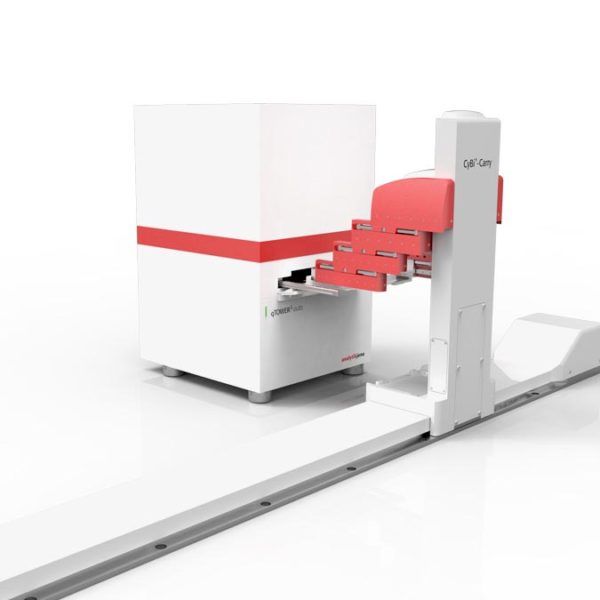
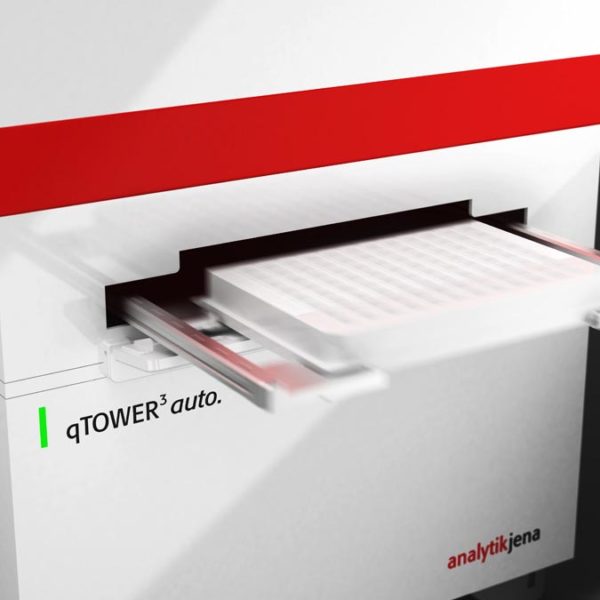
In addition to the externally accessible sample tray, plate handling is also automated in qTOWER³ auto. The 96 well microplate is positioned precisely within the block and, following amplification, is unloaded just as efficiently. Visualizing a continuous workflow is easy and reliable. The concept of automated real-time PCR accommodates a variety of integration strategies. The length of the cable for the decoupled electronics module is up to 10 m, making it easy to integrate from a decentralized location. The size of the rest of the instrument is then only just 27.5 cm x 46 cm x 31 cm (W x H x D), and the height of the sample tray (minimum = 12 cm) is easy to adjust. The cycler unit can be positioned next to the liquid handling system to save space, in which case the plate is loaded using an external robotic arm (as used in the CyBi®-Carry) or by directly connecting the sample tray to the liquid handling station.
- Description
- Features
- Technical Data
Description
Optimum Data Handling
The system automatically carries out the following steps as a basis for all further analyses: performs threshold and Ct determinations on each sample, generates standard curves, and determines PCR efficiency. Depending on the assay and the desired level of information, these are followed immediately by the below shown methods:
- Absolute or relative quantification
- ddCt method with or without efficiency
- Determination of point mutations using probe based, allelic discrimination (genotyping)
- POS/NEG analysis by endpoint determination
- Melting curves and protein analysis
- Multi gene or multi plate analysis respectively
High-Performance Optical System
The automated cycler is every bit as powerful as the comparable stand-alone version of qTOWER³. The heart of the high-performance optical system (FOS – Fiber Optic System) is the patented, optical shuttle with 8 optic fibers, which optimizes excitation for each individual sample, while detecting the emitted fluorescence signals with extraordinary homogeneity. The system is rounded out by its novel light source, which consists of 4 long-lasting, intense LEDs in red, green, blue and white (RGBW), delivering highly selective extinction as a function of the selected dye.
qTOWER³ auto is equipped with supporting filter modules that include a finely tuned set of excitation and emission filters. Depending on the application, customers can choose from 6 Color Modules, 5 FRET Modules and one Protein Module, up to 6 of which can be installed in the instrument. This allows the system to carry out highly sophisticated multiplex applications, from the blue to near infrared range. The system reads out the 96 well plate in just 6 seconds, regardless of the number of filter modules.
Modern Silver Sample Block
The sample block is the foundation of any PCR or real-time PCR system. qTOWER³ auto uses a combination of high-quality silver and a gold coating to generate heating rates of up to 8 °C/ sec. At the same time, the system also delivers excellent control accuracy to within just
± 0.1 °C of the target temperature. The optimized temperature control algorithm makes the thermocycler the ideal system for quantitative and qualitative real-time PCR applications. In addition, qTOWER³ auto also comes equipped with a motorized heating lid that can be set to temperatures of up to 110 °C. The optimum, automatic contact pressure of the heating lid perfectly seals the PCR plates used.
qTOWER3 auto - Real-Time PCR meets Automation
- Convenient: 12 available Color, FRET and Protein Modules can be exchanged or reconditioned within 5 minutes
- Future-proof: Adaptable to new applications at any time
- Robust: Patented high performance optical system with a long-term warranty of 10 years
- Fast: Heating rates of 8 °C/sec and cooling rates of 6 °C/sec
- Unrivaled: Ideal homogeneity and temperature control accuracy (± 0.1 °C)
- Comfortable: Automated plate handling by moveable sample tray
- Intelligent: Decoupled electronic module with 10 m cable for peripheral positioning
- Universal: Automatic data evaluation form a simple overview of Ct
values up to ddCT method and multi plate analysis - Transparent: Reliable data management based on different export
functions and a LIMS transfer file - Efficient: Short scan times of 6 seconds for the entire plate, regardless of the number of dyes detected
- Innovative: Novel light source with 4 robust LEDs – no preheating
- Brillant: Ideal illumination and excitation of all 96 probe without
fringe effect
| Thermal block | |
|---|---|
| Sample block | Silver sample block with gold-coating |
| Block capacity | 96 Well Microplates (0.2 ml) |
| Sample size | 10 – 60 μl |
| Heating | Up to 8 °C/sec (max.) |
| Cooling | Up to 6 °C/sec (max.) |
| Adjustable temperature range | 4 °C to 99 °C |
| Temperature uniformity | 55 °C ± 0.15 °C after 15 sec |
| Temperature control accuracy | ± 0.1 °C |
| Heated lid | |
| Lid temperature | 30 °C to 110 °C |
| Contact pressure | 10 kg, automated |
| qPCR application | |
| Sensitivity | Detects 1 copy of target sequence in human genomic DNA |
| Dynamic range | 10 orders of magnitude |
| Multiplex analysis | Up to 6-fold |
| Optics | |
| Measuring principle | Fiber optic shuttle system with 8fold scanner and color modules for excitation and emission filters |
| Light source | 4 longlife, high-power LED’s (RGBW) |
| Detector | High sensitive PMT (Photo Multiplier Tube) |
| Color modules |
|
| Read out time | 6 sec for 96 wells independent of the number of dyes |
| Configuration | Free configuration in device |
| Upgradeability | Possible without service |
| Control | |
| Control | qPCRsoft or optional interface for automation software |
| Export function | Excel, *.csv, LIMS, qBase+, GeneIO, GenEx |
| Additional technical data | |||
|---|---|---|---|
| Weight | Approx. 30 kg | ||
| Dimension (W x H x L) |
|
||
| Recommended footprint | 10 – 15 cm behind rear side of device | ||
| Interface | USB, RS232 | ||
| Noise emission | 45 db | ||
| Power consumption | Max. 850 W | ||
| Power supply | 100 – 240 V | ||
| Warranty |
|
||
| Parameters: color modules | |||
|---|---|---|---|
| Name | Excitation | Emission | Dyes* (examples) |
| Color module 1 | 470 nm | 520 nm | FAMTM, Sybr®Green, Alexa488® |
| Color module 2 | 515 nm | 545 nm | JOETM, HEXTM, VIC®, YakimaYellowTM |
| Color module 3 | 535 nm | 580 nm | TAMRATM, DFOTM, Alexa546®, NEDTM |
| Color module 4 | 565 nm | 605 nm | ROXTM, TexasRed®, Cy3.5® |
| Color module 5 | 630 nm | 670 nm | Cy5®, Alexa633®, Quasar670TM |
| Color module 6 | 660 nm | 705 nm | Cy5.5®, LightCycler Red® |
| FRET module 1 | 470 nm | 580 nm | FAMTM (donor) / TAMRATM(acceptor) |
| FRET module 2 | 470 nm | 670 nm | FAMTM (donor) / Cy5®(acceptor) |
| FRET module 3 | 470 nm | 705 nm | FAMTM (donor) / Cy5.5®(acceptor) |
| FRET module 4 | 515 nm | 670 nm | JOETM (donor) / Cy5®(acceptor) |
| FRET module 5 | 470 nm | 605 nm | FAMTM (Donor)/ROXTM (acceptor) |
| Color modul Protein 1 | 490 nm | 580 nm | SYPRO® Orange |


